Pianist's Guide

Recommendations

Digital Piano & Gear Recommendations

Three instruments, three different players — what each is good at, where it falls short, and who should walk past it.

Written by a longtime pianist who has spent a great deal of time comparing how digital pianos sound, and who plays through JBL 305P MkII monitors at home.

The three tiers at a glance

Jump straight to the tier that matches how you play, or read on for the full breakdown.

Disclosure: the product links on this page currently point to manufacturers’ own product information and are not affiliate links — Keystone Piano Co. has no active commission links today. Affiliate links may be used in the future; when they are, Keystone may earn a commission at no extra cost to you. Commission never determines what is recommended here — full disclosure.

How to use this page

Most digital piano recommendations fail for the same reason: they rank instruments as though every buyer wants the same thing. A beginner practising in a bedroom, a teacher playing four hours a day at home, and a church musician running into a PA are solving three unrelated problems, and the "best" piano is different in each case.

So this page is organised by player rather than by score. Read the tier that matches how you will actually spend your time at the keyboard, and treat the other two as context. Each entry states plainly who should not buy that instrument, because a recommendation without that is just advertising.

One theme runs through all three tiers: how a digital piano is amplified matters as much as which digital piano you buy. A fine instrument through poor speakers sounds worse than a modest instrument through good ones. That is why the second half of this page is about monitors, subwoofers, cables and PA speakers rather than more pianos. If you are weighing that question on its own, start with Do You Need Studio Monitors for a Digital Piano?

Three recommendations by player

Beginner / Best Value

Yamaha P-145

Who it suits: Adult beginners, returning players and students who need 88 properly weighted keys without paying for features they will not use in the first few years.

Key strengths

  • 88 full-size weighted keys with a graded action that is heavier in the bass and lighter in the treble, so dynamics translate reasonably well to an acoustic piano.
  • Compact and light enough to move, store upright against a wall, or carry to a lesson or rehearsal.
  • A simple, uncluttered control layout — you spend your time playing rather than navigating menus.
  • Headphone practice is genuinely usable, which matters in apartments and shared houses.

Limitations

  • Small built-in speakers. They are fine for practice in a quiet room and underwhelming in a large or lively space.
  • A modest sound set and limited onboard editing compared with instruments two or three times the price.
  • No premium extras — no elaborate resonance modelling, no advanced connectivity, no built-in recording workflow.

The P-145 earns its place because it spends its budget where a beginner actually benefits: a real weighted action and a credible acoustic piano tone. Most of what it leaves out is what a first-year player would not touch anyway. If it eventually becomes a second instrument, it is small enough to keep.

Who should skip it: Skip it if you already play at an advanced level, need powerful onboard amplification for a room full of people, or intend to record seriously.

Learn More

Links to Yamaha’s official product information.
Serious Home Pianist

Roland FP-90X

Who it suits: Intermediate to advanced players who practise daily at home, teach, or accompany, and want an instrument that sounds convincing in the room without external speakers.

Key strengths

  • A substantial multi-driver onboard speaker system — the single biggest reason it feels like a real instrument at home rather than a controller with a piano sound.
  • A hybrid wood-and-moulded key action with escapement, which gives more nuance at soft dynamics than most portable instruments.
  • A deep, expressive piano engine with a wide dynamic range that rewards better technique instead of flattening it.
  • Full connectivity for practice and light recording: balanced outputs, USB audio and MIDI, mic input, and Bluetooth.

Limitations

  • It is heavy for a 'portable' piano. Gigging with it regularly means a case, a stand and, realistically, a second pair of hands.
  • The price sits well above entry level, and a beginner would not use most of what they are paying for.
  • The feature depth invites menu-diving. Setting it up the way you like takes an evening.

For a home pianist, amplification is not an accessory — it is half the instrument. The FP-90X is one of the few portable pianos whose built-in speakers can carry a room on their own, and pairing that with an action that responds properly at quiet dynamics makes it a genuinely satisfying daily practice instrument.

Who should skip it: Not the right choice if you mostly play through headphones on a tight budget, or if you need something light enough to load in and out weekly on your own.

Learn More

Links to Roland’s official product information.

My Top Recommendation

Premium / Professional

Roland RD-2000EX

Who it suits: Advanced players, church musicians, session and touring players — anyone whose instrument has to hold up under a microphone, through a PA, and in front of people.

Key strengths

  • A professional hammer-action keyboard with wood-and-moulded construction that stays controllable through long, demanding sets.
  • Two independent sound engines — a dedicated acoustic piano engine alongside a broad synth and electric-piano section — so you are not compromising the piano tone to get the other sounds.
  • A real performance control surface: faders, knobs and eight zones for splitting, layering and driving external gear live.
  • Studio-grade I/O, including balanced outputs and multi-channel USB audio, which removes most of the friction from recording.

Limitations

  • No built-in speakers. You must budget for monitors, a PA, or headphones — it is not a plug-in-and-play living-room instrument.
  • It is a stage piano in weight and price, and the control surface is more than a purely home player needs.
  • The depth of the sound architecture takes real time to learn if you want more than the excellent default pianos.

This is my top recommendation for players whose piano has to work in more than one context. The action holds up, the piano tone survives amplification and a microphone without turning brittle, and the I/O means the same instrument covers practice, recording and Sunday morning without compromise.

Who should skip it: Do not buy it as a first piano, and do not buy it expecting sound out of the box — without amplification it is silent, and the accessory budget is real.

Learn More

Links to Roland’s official product information.

The Setup

Build the RD-2000EX Setup

The RD-2000EX has no built-in speakers, which is deliberate: it assumes you will choose your own amplification. That is an advantage if you plan for it and a problem if you do not. Here is how I would build the setup around it, in the order I would buy the pieces. The same logic applies to any speakerless stage piano.

Core nearfield pair

JBL 305P MkII studio monitors

A pair of 5-inch powered nearfield monitors is the natural partner for a speakerless stage piano in a home room. They are designed to be listened to from a few feet away, and they reproduce a piano's transients and dynamic range far more honestly than consumer speakers, which tend to flatter the midrange and blur the attack of a note. I use the 305P MkII in my own room, and the practical benefit is that quiet playing stays audible and detailed instead of disappearing.

Trade-offs: They are honest rather than flattering — a thin piano patch will sound thin. They also need balanced cables, mains power for each speaker, and sensible placement at ear height.

Low-end extension

JBL LSR310S 10-inch powered subwoofer

A 5-inch monitor cannot reproduce the bottom octave of a piano. Adding a 10-inch powered subwoofer restores the weight under low chords and octaves, so the instrument feels grounded rather than polite. This model is designed to integrate with the 305P MkII, so the crossover and levels are straightforward to set rather than a guessing game.

Trade-offs: A subwoofer is easy to over-set. Too much level and everything sounds impressive and inaccurate. It also needs floor space, and in an apartment the low end travels through walls in a way monitors alone do not.

Supporting accessory

Monitor stands or isolation pads

Monitors sitting flat on a desk or on top of the piano transmit vibration into the furniture and sit below your ears, which dulls detail. Get the tweeters roughly level with your ears when seated at the keyboard, either on dedicated stands or on isolation pads. This costs very little and changes the sound more than most upgrades at this price.

Trade-offs: I have no specific model to recommend here. Buy stands rated for the weight of your monitors and tall enough for a seated playing position.

No specific product link — buy to the specification described above.

Supporting accessory

Balanced audio cables (TRS or XLR)

Run balanced cables from the piano's outputs to each monitor. Balanced connections reject the hum and buzz that unbalanced cables pick up over longer runs near power supplies and computers. Match the connector to your gear — most stage pianos offer balanced 1/4-inch TRS outputs, and most monitors accept TRS or XLR.

Trade-offs: Again, no specific product recommendation. Buy the shortest length that reaches comfortably; excess cable coiled behind a desk is a common source of noise.

No specific product link — buy to the specification described above.

Performance amplification

A powered PA speaker for live and church use

Studio monitors are the wrong tool in a room full of people. For live playing, worship services or rehearsals, use a proper powered PA speaker — typically a 10- or 12-inch two-way active cabinet with a balanced input, enough output to be heard over a band, and a pole socket so it can be raised above head height. Two of them give you stereo piano, which is worth it if the room allows. Consumer soundbars and Bluetooth speakers are not a substitute: they lack the headroom, the balanced input and the dispersion to cover an audience.

Trade-offs: PA speakers are heavy, need mains power at the speaker position, and are overkill in a bedroom. If you only ever play at home, skip this entirely.

No specific product link — buy to the specification described above.

Practical buying tips

These are the questions worth answering before you spend anything, whichever instrument you end up with.

Weighted key action comes first

Everything else can be replaced later; the action cannot. Look for 88 full-size, graded, hammer-weighted keys, and judge them at soft dynamics rather than by hammering fortissimo chords. A good action lets you play a genuinely quiet note that still speaks. If a keyboard makes pianissimo control feel like guesswork, no amount of sound quality will fix it.

Judge the piano sound on headphones and in the room

Digital pianos are usually demonstrated with a bright, reverb-heavy preset that is impressive for thirty seconds and tiring for an hour. Listen to a plain, dry piano patch. Ask whether the tone changes character as you play harder, whether repeated notes sound identical, and whether sustained chords decay naturally. Those are the qualities you notice after six months.

Built-in speakers versus external monitors

Built-in speakers are convenience; external monitors are accuracy. If you want to sit down and play without switching anything on, buy an instrument with a serious onboard speaker system. If you already have or want monitors, a speakerless stage piano puts the whole budget into the action, the sound engine and the I/O. Buying a speakerless piano and then never buying amplification is the most common expensive mistake I see.

Be honest about the room

Measure the space before you fall for an instrument. Account for the bench, the pedal position and the room to stand up. A subwoofer needs floor space and shared walls make it a bad idea. A lively room with hard floors will exaggerate brightness, and a heavily furnished one will swallow the top end.

Decide now whether you will record or perform

Recording and live playing change the requirements. Recording pushes you towards clean balanced outputs and USB audio so you can capture the piano without an extra interface. Live playing pushes you towards fast, reliable sound switching, splits and layers, and durability. If neither applies, you can safely ignore both and spend the money on the action and the speakers.

Check the connections you will actually use

Two headphone jacks matter for teaching. A sustain jack that supports a continuous half-pedal matters for classical repertoire. Balanced outputs matter for amplification. USB-MIDI matters for software. Bluetooth is convenient for backing tracks. Confirm the specific sockets rather than assuming a price tier includes them.

Budget for the whole setup, not just the piano

A realistic budget includes the stand, the bench at the right height, a proper pedal, headphones, and — for a speakerless instrument — monitors, stands and cables. Those extras can add a meaningful fraction on top of the instrument price. It is better to buy one tier down on the piano and fund the setup properly than to own a fine instrument you cannot hear well.

Affiliate disclosure

At present, the product buttons on this page point to the manufacturer’s own product information and are not affiliate links; Keystone Piano Co. has no active commission links today. In the future, affiliate links may be used on this site, and when they are, Keystone may earn a commission from qualifying purchases at no additional cost to you. Commission never determines what appears here: the instruments and equipment on this page are recommended on musical grounds, and each entry states its limitations and who should not buy it.

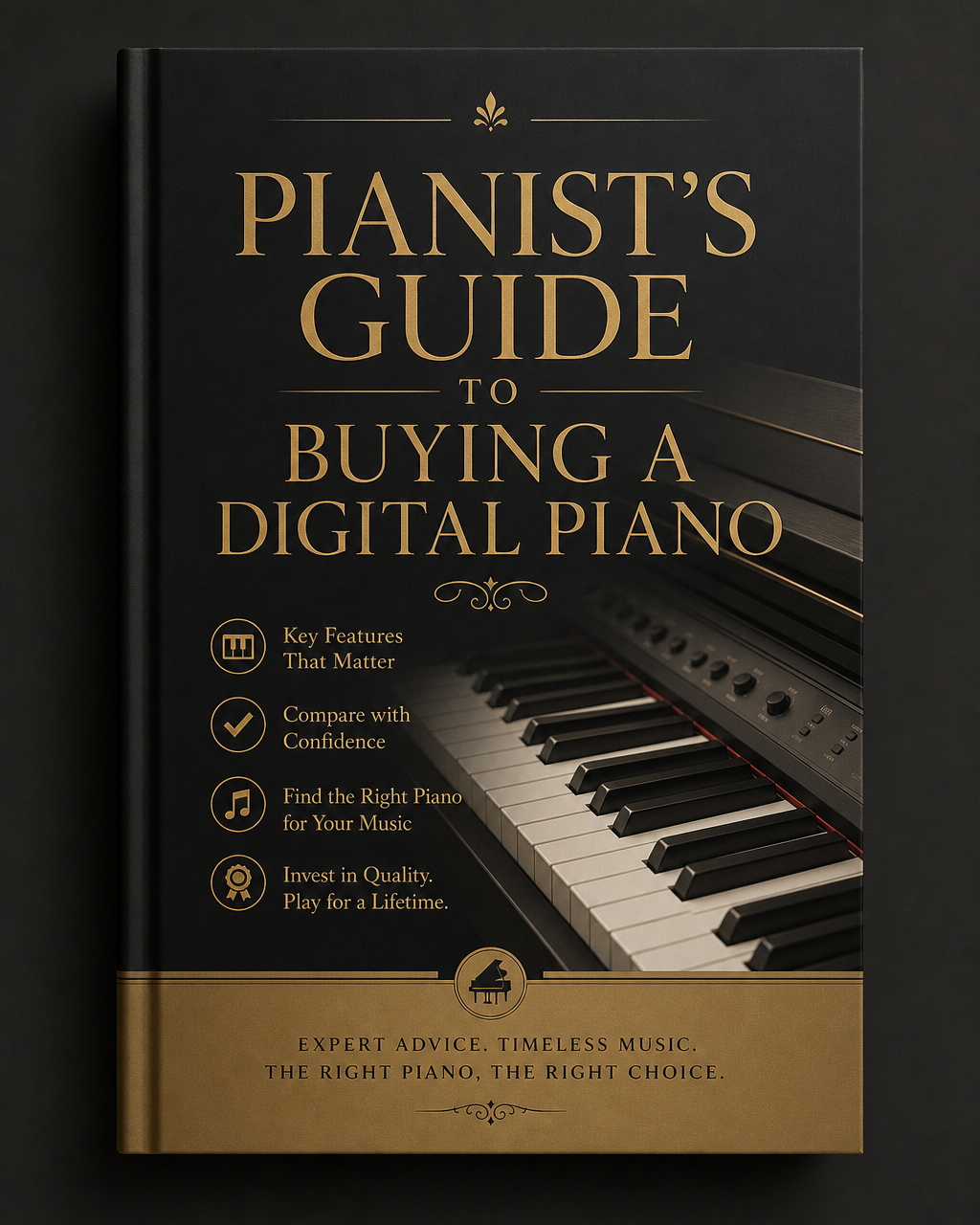
Cover of the ebook A Pianist's Guide to Buying a Digital Piano

Go deeper before you buy

A Pianist’s Guide to Buying a Digital Piano covers the reasoning behind these picks in full — how to evaluate an action, how to listen past a showroom demo, what to budget for amplification, and a printable checklist to take with you when you shop.

Instant PDF download. 14-day money-back guarantee.